
We Grew Moringa for Three Years. Here's What the Miracle Tree Actually Delivers - and What It Doesn't.
Moringa is sold on numbers that mostly aren't true. We grew it in Southern California, then read every human trial we could find. Here is the honest version: the one nutrient claim that holds up, the meta-analysis nobody quotes, the outbreak nobody mentions, and the growing data that actually changes your yield.
Disclosure: Some links in this article are affiliate links. If you purchase through them, we may earn a small commission at no extra cost to you. We only recommend resources we genuinely believe in.
There is a sentence that appears on almost every moringa page on the internet.
"Moringa contains 92 nutrients and 46 antioxidants."
I went looking for where that number comes from. Not to debunk it - I was writing a plant profile and I wanted a citation. I searched the nutrition databases. I searched the review literature. I searched the phytochemistry papers that catalogue moringa's compounds one by one.
There is no source. Not a weak source. Not an old source. No source at all. The number appears fully formed on supplement pages, gets copied, and travels. It is the most-repeated fact about this plant and nobody can tell you where it came from.
That was the moment this article changed shape.
Because I have been growing moringa in Southern California for three years. It is in my pots. It is in my ground. I have watched it die back in frost and come back in April. I know what this tree does in a garden. And when I finally sat down and read the human trials instead of the marketing, I found something that almost nobody writing about moringa has bothered to notice:
The health writers have never grown the plant. The growing writers have never read a trial. Nobody is doing both.
So here is both.
Before you scroll: test yourself
True or false — four claims moringa is sold on. Tap your guess.
"Moringa has 7x the vitamin C of oranges"
"Moringa has 25x the iron of spinach"
"Moringa has 4x the calcium of milk, and your body can use it"
"Moringa contains 92 nutrients and 46 antioxidants"
Part One: The Numbers That Aren't True
Let's clear the table first, because you cannot have an honest conversation about a plant while four false numbers are sitting in the room.
"Seven times the vitamin C of oranges"
False. The real figure is closer to three times, by weight of dried leaf powder - and weight of dried powder is the trick that makes every one of these claims work.

You do not eat 100 grams of moringa powder. You eat a teaspoon. Ten grams of moringa powder gives you roughly 17 mg of vitamin C. One orange gives you about 70 mg.
The orange wins. It isn't close.
There's a second problem nobody mentions. Fresh moringa leaves test at 162 ± 63 mg of vitamin C per 100 g. Dried leaves test at 172 ± 37.7 mg per 100 g. Drying is supposed to concentrate nutrients - the water leaves, everything else stays. If drying concentrated vitamin C, the dried number should be five or six times higher.
It isn't. It's basically the same. Which means drying destroys vitamin C at almost exactly the rate it concentrates it. The two effects cancel out. Every gram of moringa powder in the world quietly demonstrates this and no label mentions it.
"Twenty-five times the iron of spinach"
Misleading in a way that matters medically.

The gram-for-gram comparison is roughly defensible on paper. The absorption is not. Moringa's iron shows a haem iron equivalent of 0.05 to 0.4. Iron supplements run 2.6 to 2.7. That is a five to fiftyfold difference in what your body can actually take up.
If you are anemic, moringa is not an iron strategy. Treat that as a medical sentence, not a gardening one. Talk to a doctor, not a powder.
"Three times the potassium of bananas"
False at the level of the serving. A banana contains roughly three times the potassium of a realistic moringa serving. The comparison only works if you eat a third of a cup of dry powder, which nobody does and nobody should.
"Ninety-two nutrients and forty-six antioxidants"
Fabricated. As covered above - there is no scientific source. If a brand puts this on their packaging, you have learned something useful about that brand's relationship with evidence.
Part Two: What the Human Trials Actually Found
This is the part that took the longest and the part almost nobody publishes, so I want to be precise about it.
In 2025, a GRADE-assessed meta-analysis of moringa's cardiometabolic effects was published in Nutrients (2025, 17(22):3501). GRADE is the framework clinicians use to rate how much confidence a body of evidence deserves - high, moderate, low, or very low.
Moringa's rating, across every single outcome measured, was "very low."
Here's what that looks like in practice:
Fasting glucose: pooled standardised mean difference of -0.12, with I² = 0%. That I² number matters. Zero heterogeneity means the studies agreed with each other almost perfectly - and what they agreed on was that the effect is essentially nothing. This is not a noisy result waiting for better data. It's a clean null.
Blood lipids: null across the board. Total cholesterol, LDL, HDL, triglycerides. Heterogeneity between 81% and 91%, meaning the studies wildly disagreed with each other, which is its own kind of answer.
Blood pressure: here is the one that stopped me. No trial has ever tested moringa for blood pressure in people who actually have high blood pressure. The BP studies were run in normotensive participants. The single most common reason a person reaches for moringa has never been studied in the population that reason applies to.
The cancer claim
Moringa is sold heavily as an anticancer plant. I wanted a count rather than an impression, so instead of taking a review article's word for it I went to the place where trials are logged and counted them myself.
A word on what that registry is, because it matters. ClinicalTrials.gov is not a regulator and it does not evaluate, approve or rate anything. It is a public sign-up sheet - a list that researchers file into before they run a study, so the study exists on the record whether or not the result is ever published. Most of the moringa entries on it were filed by universities in India, Nigeria, Egypt, Malaysia and Thailand, not by any Western agency. Counting it tells you what work people are doing. It tells you nothing about what any government thinks of the plant, and I am not asking you to treat it as an authority. I am asking you to treat it as a headcount.
Searching moringa as an intervention against cancer as a condition returns zero studies.
Broadening to every registered moringa trial of any kind returns 51 studies. Not one of them is oncological. They cover prediabetes, malnutrition, lactation, anemia, dental health, HIV, rheumatoid arthritis, osteoporosis and metabolic syndrome.
Cell cultures are not people. A compound that kills cancer cells in a dish is a research lead, not a treatment. Anyone selling moringa on a cancer claim is making a claim with no human evidence behind it at all - and in most countries, an illegal one.
Why that number is zero, and what it does not prove
I want to be careful here, because "no trials" is easy to hear as "it was tested and it failed." That is not what happened. It was never tested.
Phase III cancer trials cost somewhere between fifty and a hundred million dollars. Nobody spends that without a patent at the end of it, and moringa cannot be patented - it is a tree, it has been eaten for millennia, and anyone can grow it in a pot. There is no owner to fund the study and no monopoly to recoup the cost. The trials that do exist on moringa were mostly run by universities in countries where the tree already grows, on budgets that stretch to a hundred participants and a few months, not to oncology.
So the honest reading of that zero is: the evidence is thin because of how research gets paid for, not because moringa was put in front of the question and came back negative. Absence of evidence is not evidence of absence, and I don't want this article to smuggle one in as the other. Whole-plant medicine is structurally under-studied, and that is an economic fact, not a scientific verdict.
But it cuts both ways, and I'm not going to soften this part either. "Nobody has looked" is not a reason to believe. It is a reason to say we don't know - and someone with a cancer diagnosis, deciding what to do next, deserves to be told that plainly rather than sold a maybe. Grow it, eat it, enjoy it. Do not let anyone put it between you and a treatment.
Where it does look real
Two things survived the audit.
Lactation. The strongest signal in the entire moringa literature is milk volume in breastfeeding mothers: standardised mean difference of 1.010, at moderate quality. That is a genuinely large effect at a genuinely respectable evidence grade, and it is the traditional use with the deepest history behind it. Two caveats stay attached: 71.4% of the studies are Indonesian, and the better-blinded trials show the weaker effects - the classic fingerprint of an effect that shrinks as the methodology tightens. Real, probably. As large as the pooled number says, probably not.

Calcium. This is the one that surprised me, and it's the one nobody markets.
Moringa's calcium is 5.72 to 12.01% bioaccessible. Spinach's is 0.62%. That is nine to nineteen times better absorption, and the mechanism is simple and well understood: spinach is loaded with oxalates that bind calcium into an unabsorbable complex, and moringa is low-oxalate.

The popular claim that moringa has "four times the calcium of milk" is, unusually, true - and unlike the other comparisons, it survives the absorption question. If there is one honest nutritional reason to grow this tree, this is it. A low-oxalate leafy green with genuinely bioaccessible calcium is a real thing to have in a garden, especially in a plant-heavy diet.
Dr Michael Greger, who is about as sympathetic to leafy greens as a person can be, still lands on the sceptical side: a tablespoon of moringa powder, he points out, has about as much vitamin A as a quarter of one baby carrot. His question is fair. Why not just eat broccoli?
My answer, after three years, is not a nutritional one. It's that broccoli will not grow into a fifteen-foot tree in my yard that I can cut back to my knees every spring and harvest from for a decade. But that's an argument about gardening, and I'd rather say so plainly than dress it up as biochemistry.
Part Three: The Safety Conversation Nobody Is Having
Search moringa side effects and you will find a paragraph about how the root and root bark contain spirochin and should be avoided, and how the leaves are safe. It is on every page. It is repeated so consistently that it has the texture of settled knowledge.
It is also not where the actual documented harm is.
The real problem is bacterial, not botanical
Between late 2025 and this year, moringa powder has been at the centre of a rolling series of Salmonella outbreaks in the United States.
October 2025: 11 people ill, 3 hospitalised.
January 2026: this is the big one. 119 illnesses. 32 hospitalisations. 36 states plus Puerto Rico, Guam and the US Virgin Islands. Brands involved included TNVitamins, Doctor's Pride, Why Not Natural and Live it Up. At the time of writing this outbreak has not been declared over.
May 2026: a further 18 illnesses and 7 hospitalisations linked to MOGO capsules.
Pregnancy: the simplification is wrong
The standard line - leaves fine, avoid the root - is not a safe simplification during pregnancy. The abortifacient signal in the literature extends to leaf extracts, not just root preparations.
If you are pregnant, avoid moringa supplements entirely. Not the root. Not "mostly." The supplements. This is a case where the internet's tidy rule is more dangerous than no rule at all, because it grants permission it hasn't earned.
Dose, and one liver case
Studied doses in human trials run 2.4 to 8 grams per day. A teaspoon of powder is roughly 2 to 3 grams, so a standard serving sits at the low end of the studied range - which is reassuring, and worth knowing when a brand suggests three scoops.
There is one published case of probable moringa-associated liver injury. It carried a RUCAM score of 6 and, importantly, a positive rechallenge - the person stopped, recovered, resumed, and the injury returned. That is the strongest form of evidence a single case report can offer. One case out of enormous global use is not a reason for alarm. It is a reason not to say "completely safe," which is what most pages say.
The animal genotoxicity findings that occasionally get quoted appear only at doses equivalent to roughly 210 grams per day in a human. That is not a supplement. That is a diet of powder. Filed under interesting, not applicable.
None of this is medical advice. If you take medication - especially for blood sugar, blood pressure or thyroid - talk to your doctor before adding a concentrated leaf powder to your day.
Part Four: What Three Years of Growing It Actually Taught Me

Here is where the article turns, because this is the half that the health writers never reach.
Germination: the universal advice is worse than doing nothing
Every moringa growing guide tells you to soak the seeds for 24 hours before planting. Every single one.
The germination trial data says this:
| Treatment | Germination rate |
|---|---|
| Scarification (nick the seed coat) | 96.66% |
| Wet/dry cycling | 89% |
| No treatment at all | 88.33% |
| 24-hour soak | 74% |
The universal advice is the worst-performing option on the list. Doing nothing beats it by fourteen points. Scarifying - taking a file or a knife to the hard outer coat and nicking it, without cutting into the kernel - beats it by more than twenty.
I lost most of a first batch to the soak before I found this. Moringa seeds have a hard coat and a fatty kernel, and prolonged submersion appears to do more harm through anaerobic conditions than it does good through softening. Nick the coat. Plant it dry. Water normally.
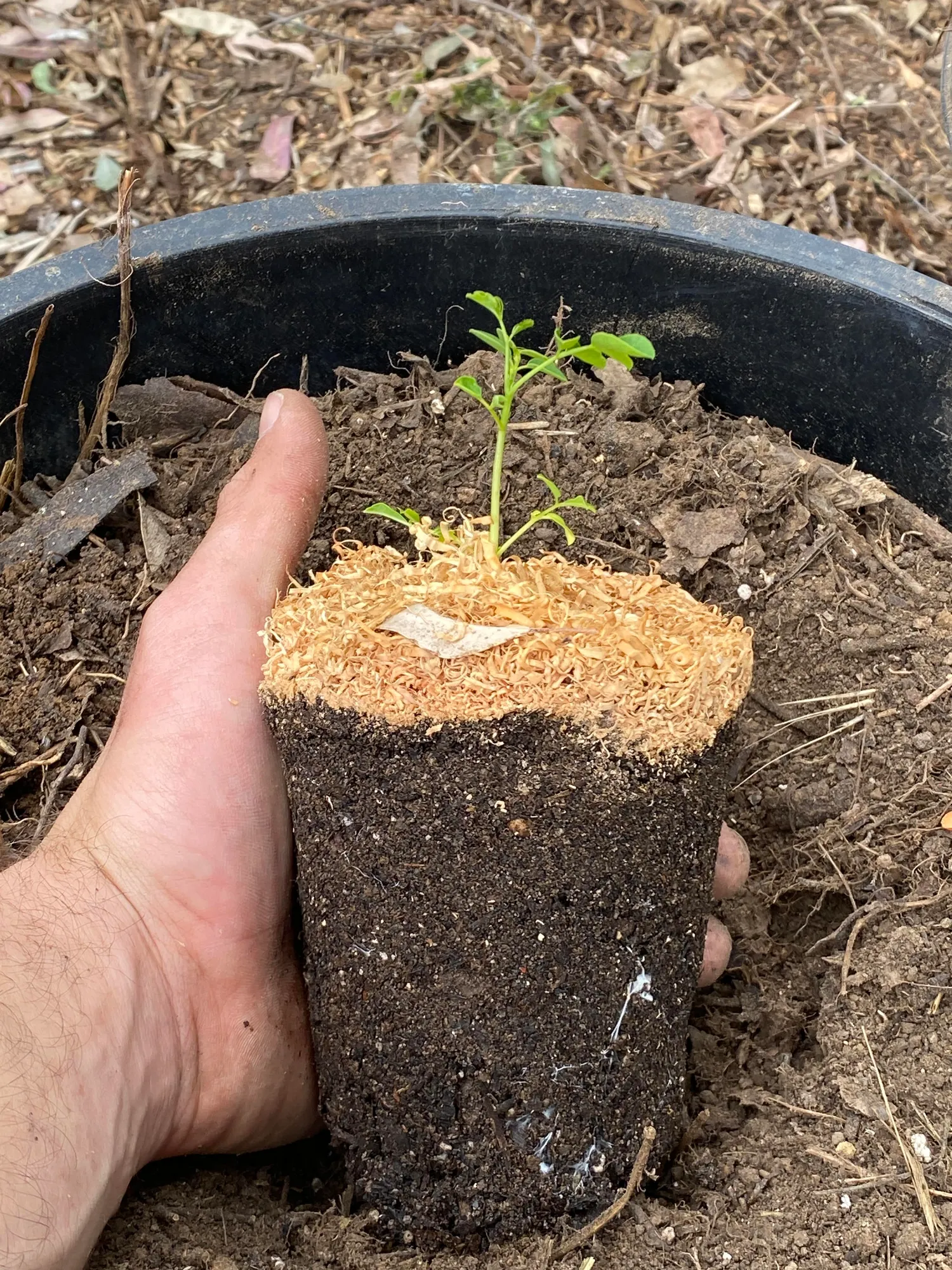
The single most valuable number I found: coppice at 20 centimetres
If you take one practical thing from this article, take this.
Moringa responds to being cut back hard. Everyone knows that much. What almost nobody specifies is the height at which to cut, and the height changes the yield substantially.
Where you cut changes everything
Tap a coppice height to see leaf yield per tree
Cutting at roughly 8 inches produces 31% more leaf than a ground-level cut and 53% more than the waist-high cut most people default to. It also pushes the tree to throw 6–10 new shoots instead of 1–2. Eight inches. Write it on the pot.

It does not fix nitrogen. Stop reading that.
You will see moringa described as a nitrogen-fixing tree in permaculture guild lists and companion-planting charts. It is not one.
Nitrogen fixation through root nodulation occurs in four plant orders: Fabales, Fagales, Cucurbitales and Rosales. Moringa is in the Brassicales - it is closer kin to cabbage and papaya than to any legume. It has no nodules and no rhizobial partnership.
The practical consequence is the opposite of what the guild charts imply: because you harvest the leaves, and leaves are where the nitrogen is concentrated, a harvested moringa tree is a net exporter of nitrogen from your system. It takes. Plan for it.
And do not respond to that by drowning it in fertiliser. In trials, a modest 100N/80P treatment produced trees 46.8% taller than a heavy 400N/120P treatment. More is actively worse. This plant evolved in poor dry soil and it behaves like it.
Frost: what actually happens in a zone 9b winter
Moringa's LT50 - the temperature at which half of tissue dies - is -2.8°C (27°F). My part of Southern California straddles that number most winters, which means moringa here is not an evergreen tree and not an annual. It is a dieback perennial. It looks dead in February and it is not.
The ECHO trial data is the reassurance I wish I'd had my first winter: after 44 separate freeze events, 49% of moringa plants resprouted. Half of them came back from the roots after being frozen forty-four times.
University of California Cooperative Extension's guidance for our conditions is simple and it works: cut the tree back to about one foot before the first hard frost and cover the stump. Mulch, frost cloth, an upturned bucket. You are protecting a crown, not a canopy.
Year one, realistically
In the ground, expect four to eight feet in the first year. In a container, three to five feet - and containers are a legitimate choice here, not a compromise, because moringa's growth rate means a pot keeps it at a harvestable height without constant ladder work.
First harvest comes at eight to ten weeks. That is faster than almost anything else you can plant that will still be there in a decade.
The thing that will actually kill your tree
Not pests. In California, moringa is essentially pest-free - I have had no meaningful insect pressure in three years.
Overwatering. Root rot is the number one killer of moringa, in the ground and especially in pots. And the reason it's so lethal is that it disguises itself: a potted moringa with yellowing leaves is almost always being over-watered, not under-watered. The instinct is to reach for the hose. The instinct is wrong. Yellow leaves plus damp soil means stop watering, check drainage, and let the pot dry out properly before you touch it again.
This tree is from the foothills of the Himalayas by way of arid India. It wants to be a little bit neglected.
Drying: where most home harvests are quietly destroyed
If you are going to make your own powder - and the Salmonella section is a decent argument that you should - the drying method is not a detail. It is most of the outcome.
Drying moringa leaves in direct sun costs you 58% of the vitamin A and 84% of the vitamin C. Direct sun is what most people do, because it is free and obvious and every video shows it.
The alternatives, from actual guidance rather than folklore:
Shade drying - roughly six days, leaves spread in a single layer with airflow, out of direct light.
Indoor drying, per UC Davis SAREP - 68 to 76°F for 54 to 72 hours.
Dehydrator - 110°F for 4 to 6 hours. Low and slow. If your dehydrator's lowest setting is 135°F, you are cooking, not drying.
The leaves should crumble between your fingers and still be green. If they've gone khaki or olive-brown, the sun got them.
What I Actually Think, After Three Years
Moringa is not a miracle tree. The word "miracle" is doing an enormous amount of commercial work and none of it is supported by the human evidence.
What moringa is, is a remarkably good garden plant with one genuinely excellent nutritional property.
It grows faster than anything else in my yard. It comes back after frost that should kill it. It survives neglect and punishes attention. It produces edible leaves eight weeks after planting and keeps producing for years off a stump you cut to eight inches every spring. And those leaves are a low-oxalate green with calcium your body can actually absorb - nine to nineteen times better than spinach - which is not a small thing in a plant-forward diet.
That is a real plant with real value. It doesn't need 92 fabricated nutrients to be worth your space.
What it needs is for someone to stop selling it and start growing it.
Sources and How to Check Me
The evidence positions in this article rest on: the GRADE-assessed cardiometabolic meta-analysis in Nutrients (2025, 17(22):3501); a direct query of the ClinicalTrials.gov registry for moringa interventions, which returned 51 registered trials and zero in oncology; FDA and CDC outbreak notices for the 2025-2026 moringa powder Salmonella investigations; published bioaccessibility comparisons of moringa and spinach calcium; ECHO and UC Cooperative Extension frost and cultivation guidance; UC Davis SAREP post-harvest drying protocols; and published coppicing and germination trial data.
Where I've quoted a figure, I've quoted it to the decimal place the source used. Where the evidence is weak, I've said it's weak rather than rounding it up into a benefit. If you find I've got one wrong, tell me - I would rather correct this page than defend it.
Recommended Resource
Want to Grow Your Own Instead of Buying Powder?
The Salmonella outbreaks in the commercial moringa supply are the strongest argument I know for growing and drying your own. This is the practical backyard system I use - soil building, container selection, water efficiency and harvest planning - for people who want real food production without a big yard.
Learn More →Download the Eden Backyard Starter Kit
Everything you need to transform your backyard into a productive system — free.
- Complete garden layout plans
- Seasonal planting schedules
- Soil preparation guides
- Water-saving techniques
- Natural pest control methods
Free — no credit card required